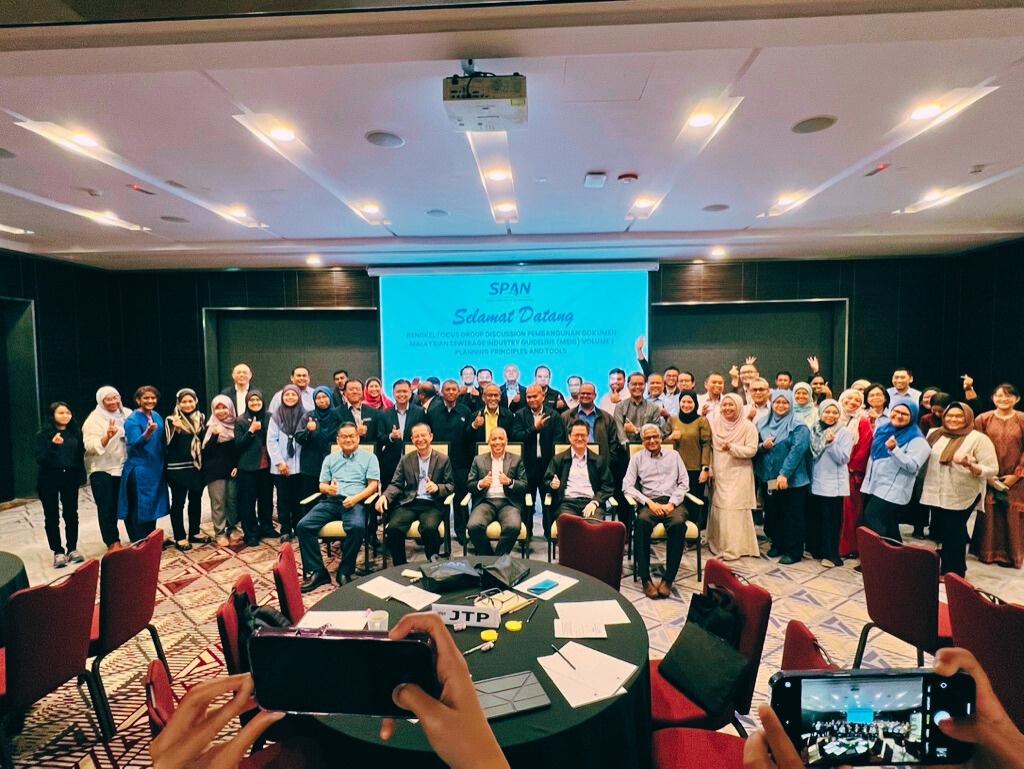

Good planning is not just about approving development. It is about shaping places that remain liveable, resilient, affordable, and environmentally responsible over the long term. This is especially true for sewerage infrastructure — often hidden underground, yet directly shaping public health, river water quality, land use, climate performance, and long-term operating costs.
Beyond the cheapest option
Sustainability in planning cannot be reduced to a single question: “Which option is cheapest?” The better question is: “Which option delivers the best overall value — including its wider co-benefits — over its full life cycle?”
This is where Multi-Criteria Analysis (MCA) and Cost-Benefit Analysis (CBA) become essential. Chapter 6 of the Malaysian Sewerage Industry Guidelines (MSIG) Volume 1 places Cost-Benefit Analysis at the centre of sustainable infrastructure planning, recognising that a sustainable project must meet the needs of the present generation without compromising the ability of future generations to meet their own.
What Multi-Criteria Analysis brings
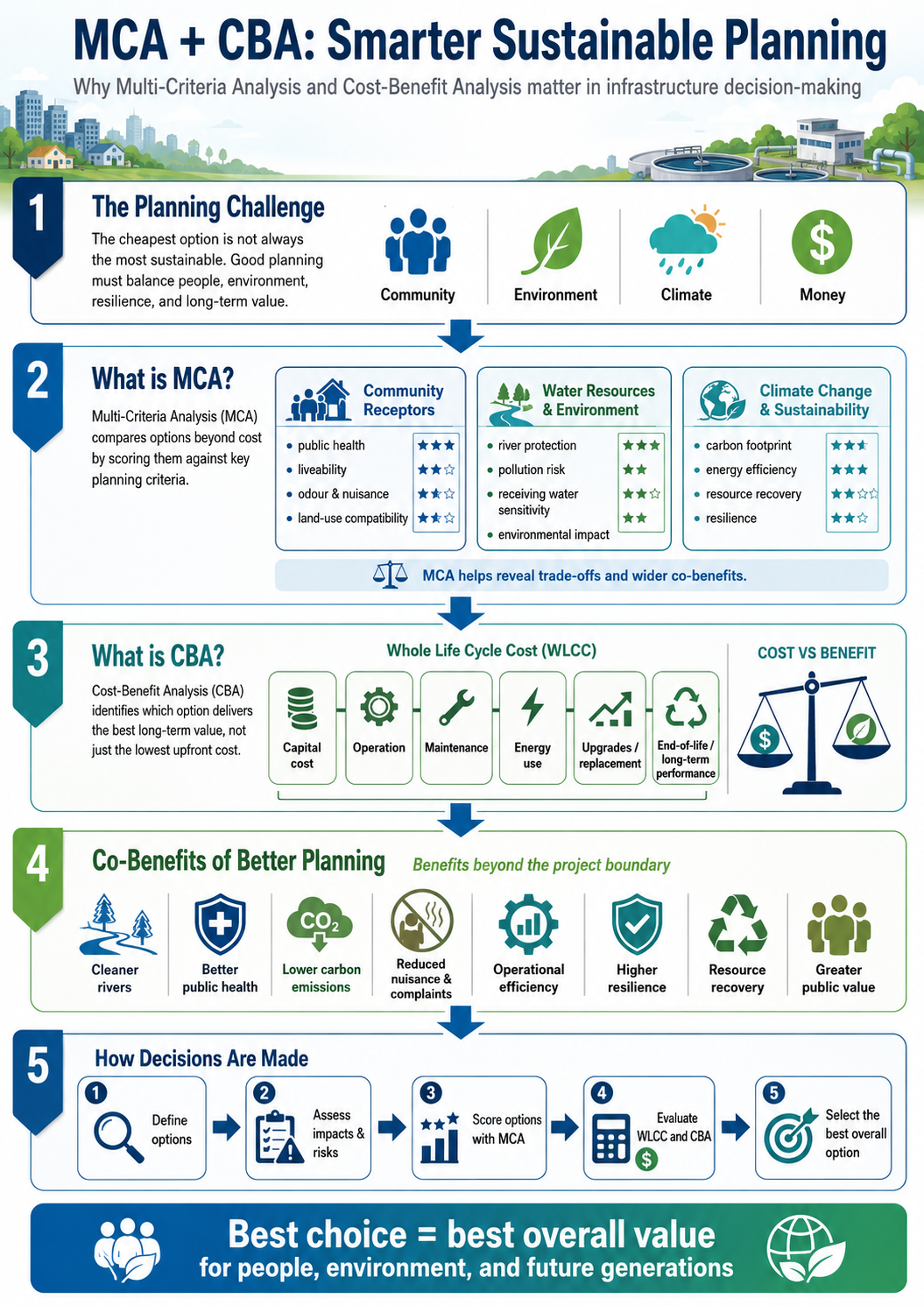
Multi-Criteria Analysis helps planners compare options beyond financial cost. It allows sewerage proposals to be assessed against wider planning considerations — community impact, water resource protection, environmental sensitivity, climate change, and sustainability outcomes.
This matters because the technically easiest or cheapest solution may not be the most suitable one for a high-risk catchment, a dense urban area, or a location close to sensitive water resources.
What Cost-Benefit Analysis brings
Cost-Benefit Analysis brings discipline to the decision. It ensures infrastructure choices are not made on capital cost alone, but on whole life-cycle cost — construction, operation, maintenance, upgrades, energy use, replacement, and long-term service performance.
In short, it helps avoid the common planning mistake of choosing a low-cost option today that becomes expensive, inefficient, or environmentally damaging tomorrow.
The real strength: revealing co-benefits
A well-planned sewerage solution does more than treat wastewater. Its wider co-benefits often do not appear in a conventional engineering cost estimate, yet they matter deeply to cities and communities:
- Reduce pollution loads to rivers and improve public health
- Lower greenhouse gas emissions and support carbon reduction
- Unlock land value and support urban renewal
- Reduce odour, nuisance complaints and discharge points
- Enable resource recovery and circular-economy goals
- Improve investor confidence in a growth area
A worked example: regional vs standalone
A regional sewerage solution may require higher initial investment than multiple small standalone systems. However, it can deliver stronger pollution control, fewer discharge points, better operational reliability, reduced odour and nuisance risks, improved river rehabilitation outcomes, and economies of scale in sludge management.
Over time, these wider benefits can outweigh the apparent savings of cheaper short-term options. Sewerage planning that protects receiving rivers also supports downstream water security, biodiversity, recreation, tourism, and climate adaptation.
Making trade-offs visible
For planners, MCA and CBA are powerful because they make trade-offs visible. They help answer difficult questions:
- Which option best protects the receiving river?
- Which option is more affordable over time?
- Which solution reduces future pollution risk?
- Which investment supports climate and sustainability goals?
- Which option creates the greatest public value beyond the project boundary?
The shift modern planning needs
Sustainability is not a slogan added at the end of a proposal. It must be built into the way options are screened, compared, justified, and approved. MCA provides the structured lens to compare multiple impacts; CBA provides the financial and economic logic to understand long-term value; and co-benefits expand the conversation to recognise wider gains across health, environment, economy, and resilience.
This matters even more amid urban growth. Cities are becoming denser, infrastructure corridors more constrained, and water bodies are under increasing pressure. Decisions made today on sewerage systems, discharge points, treatment standards, and regionalisation will shape environmental quality and public health for decades.
The future of planning is not simply about building more infrastructure. It is about choosing the right infrastructure, in the right place, for the right reasons — ensuring that every ringgit spent delivers lasting value, wider co-benefits, and better outcomes for people, the environment, and future generations.
Key takeaways
- Sustainable planning asks for the best overall value over the full life cycle, not the lowest upfront cost.
- MCA compares options across community, environmental, climate and water-resource impacts — not just price.
- CBA weighs whole life-cycle cost: construction, operation, maintenance, energy, upgrades and replacement.
- Together they reveal co-benefits — cleaner rivers, better health, lower emissions and stronger public value.