
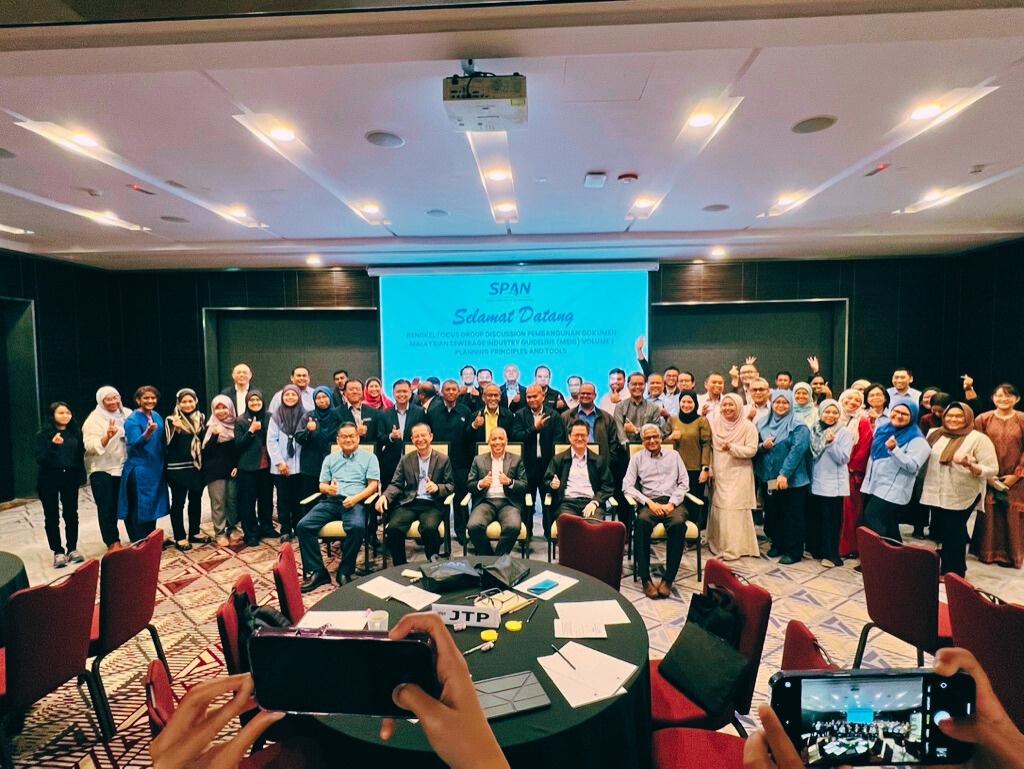
H2O Datatech recently served as co-lead, in collaboration with JIL & Associates, for the SPAN Malaysian Sewerage Industry Guidelines (MSIG Volume 1) Consultation Workshop convened by Suruhanjaya Perkhidmatan Air Negara (SPAN). The workshop assembled regulators, project owners and technical stakeholders to review and strengthen the framework governing sewerage infrastructure planning in Malaysia.
A shift to risk-based planning
Decisions on siting, land area and buffer zones are being repositioned around a structured Risk and Vulnerability Assessment. This replaces prescriptive distance-based rules with criteria grounded in exposure, sensitivity and consequence — giving approving authorities a more defensible, context-aware basis for planning decisions.
Sustainability as a design input
A dedicated chapter on Future Strategic and Green Objectives, together with explicit guidance on Carbon Footprint Measurement, embeds climate resilience and resource recovery into the planning process from the outset — rather than treating sustainability as an afterthought.
A unified evidence base
The parallel Regulator (RPO) and Industry (IPO) volumes provide approving authorities and project owners with a common reference. This improves coordination and reduces approval friction across the project lifecycle, aligning expectations between regulators and the parties delivering infrastructure on the ground.
A more adaptive, evidence-led framework
Collectively, the revised guidelines reflect a deliberate move toward planning that is more adaptive, evidence-led and aligned with Malaysia's longer-term sustainability commitments.
H2O Datatech extends its appreciation to SPAN for its stewardship of the initiative and to JIL & Associates for the partnership throughout this engagement.
Key takeaways
- H2O Datatech co-led the SPAN MSIG Volume 1 Consultation Workshop with JIL & Associates, convening regulators, project owners and technical stakeholders.
- Sewerage siting, land area and buffer zones are shifting from prescriptive distance rules to a structured Risk and Vulnerability Assessment.
- New chapters on Future Strategic and Green Objectives and Carbon Footprint Measurement embed sustainability into planning from the outset.
- Parallel Regulator (RPO) and Industry (IPO) volumes create a unified evidence base, improving coordination across the project lifecycle.